
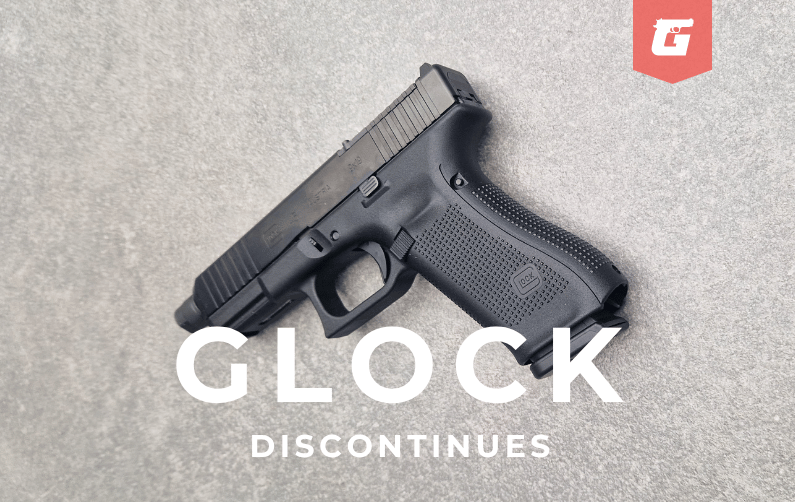
Glock Discontinues Some of Its Most Popular Models
Glock Ges.m.b.H., known for its reliable polymer-framed pistols and the distinctive “Safe Action” system, has been a benchmark in the world of sidearms used by law enforcement and civilian shooters for decades. In October 2025, the firearms industry was taken by surprise by the announcement of a wide discontinuation of Generation 3, 4, and 5 models, as Glock discontinues some of its most popular models. This decision affects not only the U.S. market but also Europe — including Poland. As Glock discontinues these models, enthusiasts are left wondering what the future holds for their favorite firearms. Interestingly, the reasons behind why Glock discontinues its models will impact future developments in the industry.
Table of Contents
This post details why Glock discontinues certain models and how this affects gun owners.
Official List of Discontinued Glock Models
According to the official manufacturer’s website (us.glock.com/en/discontinued-models), the following pistols have been marked as “Discontinued Commercial Models” — meaning they are no longer in production or available for commercial sale:
- G17 – Gen4
- G17 MOS – Gen4 | Gen5
- G17L – Classic | Gen3
- G17L MOS – Gen5
- G19 – Gen4
- G19 MOS – Gen4
- G20 – Gen3 | Gen4
- G21 – Gen3 | Gen4
- G21SF
- G22 – Gen3 | Gen4 | Gen5
- G22 MOS – Gen5
- G23 – Gen4
- G24
- G26 – Gen4
- G27 – Gen3 | Gen4 | Gen5
- G29 – Gen3 | Gen4 | Gen5
- G29SF
- G30 – Gen3 | Gen4 | Gen5
- G31 – Gen3 | Gen4
- G32 – Gen3 | Gen4
- G33 – Gen3 | Gen4
- G34 – Gen3 | Gen4
- G34 MOS – Gen4 | Gen5
- G35 – Gen3 | Gen4
- G35 MOS – Gen4
- G36
- G36 FGR
- G37 – Gen3 | Gen4
- G38
- G39
- G40 MOS – Gen4
- G41 – Gen4
- G41 MOS – Gen4
- G49
This extensive list includes both full-size and compact pistols across calibers ranging from 9mm Luger to .40 S&W, .45 ACP, .357 SIG, and 10mm Auto. In practice, it marks the end of nearly all Generation 3–5 families, except for some compact and subcompact models that remain in production.
Glock discontinues models not only for regulatory reasons but also to enhance its overall product strategy.
Why Glock Discontinues Its Iconic Models?
The current situation leads many to speculate about why Glock discontinues certain iconic models that have been widely appreciated.
1. New Regulations and Safety Requirements
In the United States — particularly in California — new regulations restrict the sale of semi-automatic pistols that could be converted to fully automatic versions (“Glock switch”). Glock has responded by simplifying its lineup and redesigning critical components to comply with stricter safety standards and prevent illegal modifications.
2. Product Modernization and Streamlining Strategy
Glock officials describe this move as part of a long-term “streamlining” strategy. Maintaining five generations of pistols across dozens of calibers and configurations has become economically inefficient. The company plans to focus on the upcoming “V-Models” series, expected to debut in 2026 — combining proven design elements with modern modular features.
3. Production Costs and Efficiency
Supporting numerous versions (MOS, SF, FGR, Classic) for each market has caused production complexity and higher logistics costs. Discontinuing older generations is a way to reduce manufacturing overhead and allocate resources to future innovation.
What Does It Mean for Users in Europe and Poland?
Still Legal, but Increasingly Hard to Find
The discontinuation of Glock models does not affect their legality for current owners. Shooters using Gen 3–5 pistols may continue to do so without any restrictions. However, new units will likely disappear from retail shelves over the next year, and certain spare parts and accessories will gradually become harder to obtain.
Service and Spare Parts
Glock traditionally maintains long-term support for discontinued firearms. Nevertheless, over time, availability of specific components such as recoil springs, magazines, and guide rods may diminish. Users are encouraged to purchase spare parts or compatible alternatives now — especially if their pistols are used intensively for training or competition.
Impact on the Secondary Market
The withdrawal of popular models like the G17 Gen4 and G34 Gen4 MOS may actually increase their collector value. Early market trends in the U.S. already show a 10–20% price rise for certain versions. A similar trend may occur in Europe, particularly among enthusiasts of older generations.
Collectors might see an increase in value for models that Glock discontinues, making them sought after in the secondary market.
Practical Recommendations for Glock Owners
- Check the status of your model. Visit us.glock.com/en/discontinued-models to confirm whether your pistol appears on the discontinued list.
- Secure spare parts. Especially important for those who train regularly or participate in competitions.
- Stay informed about new generations. The upcoming “V-Models” may bring improved ergonomics, optics-ready slides, and upgraded internal systems.
- Don’t panic. Glock has a long tradition of cross-generation compatibility — many Gen4 parts still fit Gen5 and even older pistols.
Is This the End of the Classic Generations?
Discontinuation means the end of active production, not removal from the market. Generations 3 and 4 are part of Glock’s heritage — they built its reputation for reliability. The company’s philosophy remains evolutionary rather than revolutionary, ensuring that proven design features will carry over into future models.
Conclusion
Glock’s decision to discontinue dozens of Generation 3, 4, and 5 pistols is a strategic move aimed at simplifying its product range, complying with new safety regulations, and preparing for the next phase of innovation. For European and Polish shooters, this is not the end of their current models but rather a transition period — with limited availability, rising collector interest, and growing anticipation for the new “V-Model” series.
In summary, Glock discontinues several models as part of a broader strategy to focus on innovation and compliance.
Main source: us.glock.com/en/discontinued-models
Additional sources: PewPewTactical, SoldierSystems.net, Newsweek (US Edition), Wikipedia (Glock)
For those interested in the market’s evolution, understanding why Glock discontinues its products is crucial.

