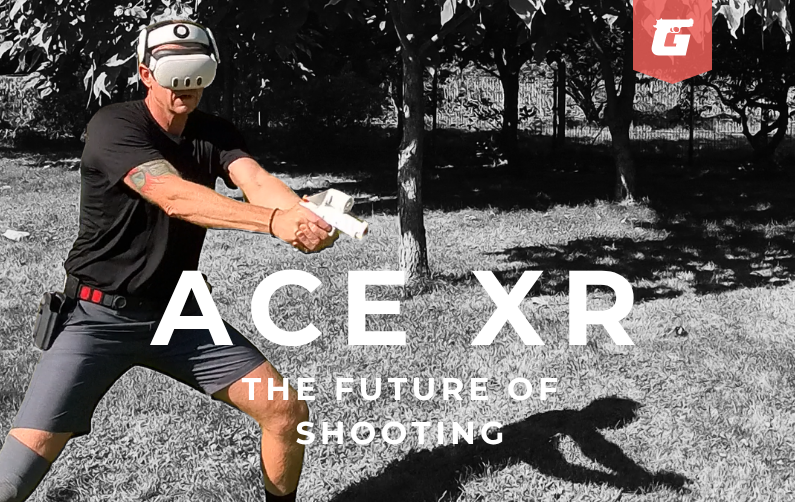
Ace XR: Virtual Shooting Training in a New Dimension
Firearms training is evolving — and technology is leading that evolution. With virtual reality now capable of recreating full shooting environments, responsible shooters can refine skills without a single live round. Ace XR represents this new era: a bridge between safety, realism, and unlimited repetition for anyone serious about performance and responsibility.
In the world of modern firearms training, extended reality (XR) and virtual tools are becoming a standard way to sharpen technique without live ammunition. One of the most interesting solutions on the market is the Ace XR Virtual Shooting Simulator — a system that combines VR technology with realistic training mechanics. For many of us who treat firearms not just as a hobby but as a serious responsibility, this can be a genuine game-changer.
What is Ace XR?
Ace XR is an advanced virtual shooting simulator designed for safe, repeatable, and technically focused training. It runs on Meta Quest 2, 3, or 3S headsets and uses a dedicated handset — a pistol-shaped shell with a mechanical trigger — to reproduce the look and feel of a handgun without live rounds, noise, or recoil. Instead, the system gives full immersion, precise motion tracking, and detailed data on every “shot.”
The platform includes:
- virtual ranges and dynamic courses,
- technical drills and competitive scenarios,
- multiplayer modes and global leaderboards,
- post-session analysis and progress reports.
Full access typically requires a subscription that unlocks the complete library of courses and regular updates.
What is Ace XR?
Ace XR is an advanced virtual shooting simulator designed for safe, repeatable, and technically focused training. It runs on Meta Quest 2, 3, or 3S headsets and uses a dedicated handset — a pistol-shaped controller with a mechanical trigger — to recreate firearm handling with full VR immersion.
Watch Ace XR in Action
Before you commit to training in VR, it’s worth seeing how the system performs in real use:
And for a closer look at course layouts and drills inside Ace XR:
Both clips give a strong practical sense of what the simulator can do: course design, target timing, movement, and how the handset and headset integrate.
Why Ace XR Is More Than a VR “Game”
On the surface Ace XR might look like another VR game. That’s deceptive. Used properly, it’s a serious training tool that can significantly improve:
- accuracy,
- reaction times,
- smoothness of transitions between targets,
- spatial awareness,
- hand–eye coordination,
- and even match/course strategy.
The system tracks hits, split-times (time between shots), and movement paths — allowing structured, technical practice rather than aimless repetition. You can drill specific weaknesses, compare sessions, and iterate deliberately.
Advantages of Virtual Training with Ace XR
1. Unlimited Repetitions
Unlike live range practice, ammunition and range time don’t limit you. Repetition builds muscle memory, and Ace XR lets us put in hundreds of quality reps safely and affordably.
2. Train Anywhere
Ace XR works indoors — at home, in a garage, or a gym space. For busy adults balancing work, family, and responsibilities, this accessibility is a huge advantage for maintaining consistent training habits.
3. Safety and Risk-Free Practice
No live ammo means no ballistic hazards. Ace XR is ideal for introducing new shooters to safe handling, for instructors teaching fundamentals, and for families who want controlled exposure to basic firearm safety (always supervised and context-appropriate).
4. Wide Range of Scenarios
The platform includes courses inspired by USPSA/IPSC, Steel Challenge, and custom dynamic drills. You can tailor difficulty, course length, and weapon profiles to match goals — from fundamentals to competitive prep.
5. Immediate Analysis and Feedback
Every shot is logged: hit location, timing, penalties, and more. Real-time feedback and post-session reports make it easier to identify trends and fix specific technical issues faster than many dry-fire routines.
What Ace XR Cannot Fully Replace
- No physical recoil. Visual recoil and animation do not equal the tactile forces of a fired handgun. We do not train recoil management or exact return-to-sight dynamics in VR.
- Simplified reloads and manipulations. Reload mechanics are modeled, but they’re not the same as handling a real magazine under stress.
- Limited environmental stressors. Lighting, wind, noise, physical obstacles, fatigue, and real stress are hard to reproduce perfectly in VR.
- Self-discipline required. VR does not punish poor fundamentals in the way live fire consequences might. We must keep standards high.
Treat Ace XR as a powerful complement to live training — a way to accelerate skill acquisition, not a total substitute.
Common Training Pitfalls (and How to Avoid Them)
1. Chasing Scores Over Technique
The instant feedback loop can make us prioritize leaderboard points rather than fundamentals. Fix: Schedule sessions focused on slow, technical work (trigger control, consistent grip) separate from “score runs.”
2. Neglecting Recoil Work
Without recoil, we don’t train recovery and follow-up shots. Fix: Periodically verify skills on the live range or with weighted replicas that reproduce balance and handling.
3. Shortened, Artificial Movement Paths
VR sometimes allows “cheating” motions that real-world handling won’t. Fix: Record sessions from the side to check natural movement patterns; limit shortcuts by practicing full-range transitions.
4. Under-Challenging Scenarios
Easy courses can breed complacency. Fix: Use time pressure, moving targets, low-visibility modes, or custom difficulty ramps to keep challenge levels realistic.
5. Ignoring Gross-Body Mechanics
VR scoring usually focuses on sight alignment and hits, not posture or footwork. Fix: Add video or coach-led review to spot body tilts, improper stance, or inefficient torso movement.
How to Integrate Ace XR into a Real Training Program
Ace XR should be one tool in a deliberately varied plan. Below is a practical hybrid model that combines VR, dry fire, and live fire to produce robust, transferable skills.
Technical Sessions — Low Tempo
Work trigger press, sight picture, and grip stability slowly. Focus on quality — not speed.
Progressive Sessions — Medium Tempo
Add target transitions, reload practice (outside VR), and moderate time pressure. Build smoothness under mild stress.
Performance Sessions — High Tempo
Timed runs and competition-style rehearsals. Keep technique prioritized; speed is a consequence of good fundamentals.
Manipulation Work — Outside VR
Train magazine changes, malfunction clears, and handling drills with real or replica gear. VR does not replace tactile familiarity.
Verification on the Live Range
Regularly test what you practiced in VR under live conditions. This is the single most important step to ensure your VR gains transfer.
Who Benefits Most from Ace XR?
Ace XR is useful for:
- shooters who want structured practice without the recurring cost of ammo,
- people with limited range access,
- competitors seeking extra reps on course strategy and transitions,
- instructors introducing safe fundamentals in a controlled environment,
- families and responsible adults wanting an accessible training tool.
It’s especially effective as a supplemental tool for people who combine VR practice with manipulation drills and scheduled live-fire verification.
Practical Tips to Maximize Ace XR
- Plan sessions: Alternate technical, progressive, and performance days. Set goals and keep logs.
- Record and review: Use a camera to capture posture and movement; combine that with Ace XR’s analytics.
- Limit “score-only” runs: Reserve at least half your weekly sessions for quality work.
- Simulate imperfection: Add low-light courses, distractions, and movement to reduce overfitting to ideal scenarios.
- Pair with dry fire: Keep tactile skills sharp with real-world dry-fire and manipulation drills.
- Schedule live checks: Monthly or quarterly live-fire sessions (depending on VR volume) validate progress.
Final Thoughts — Technology Serving the Responsible Shooter
Ace XR isn’t “just a game.” It’s a training platform that lets us practice more often, more deliberately, and more safely. It won’t replace the feel of recoil or the complexities of real-world conditions, but it excels at developing sight picture, transitions, decision timing, and consistent technique — all crucial building blocks for live-fire performance.
Technology raises responsibility, not replaces it. If we use Ace XR the right way — as a tool inside a broader, disciplined training program — it can make us better, safer, and more confident shooters. Being a good guy with a gun means training intentionally, acting responsibly, and integrating learning into everyday life.
👉 Explore more VR & dry-fire training resources:
https://goodguyswithguns.eu/virtual-training-for-shooters