Dry Fire Training – The Shooter’s Secret Weapon
Table of Contents
- Why Dry Fire Training Matters
- Safety First – Rules Before Training
- What Does Dry Fire Give Us?
- Dry Fire for Beginners – How to Start
- Common Myths About Dry Fire
- What Can We Train With DF?
- Common Mistakes in DF
- What’s Next – The Series Roadmap
- Conclusion
Why Dry Fire Training Matters
We all know the feeling: leaving the range with the thought that we could have shot better. The problem is that ammo is expensive, range time is limited, and the noise and pressure often make it hard to focus on the details.
That’s where dry fire training comes in – training without live ammunition. It’s a tool that lets us practice the most important elements of shooting at home, every day, in short sessions. No noise, no smoke, no pressure – just us, the gun, and habits we build step by step.
This article is the first of a 4-part series on Dry Fire Training, guiding you from absolute basics to advanced drills that transfer directly to live fire.
Safety First – Rules Before Training
Before we go any further, let’s be clear: dry fire is still working with a firearm. Even if the mag and chamber are empty, we treat the gun as if it’s loaded.
- Check the gun three times – mag out, slide locked back, visually and physically inspect the chamber.
- No live ammo in the room – keep it in another place.
- Safe direction – always practice toward a solid wall or a backstop that could stop a bullet.
- Calm and focused – no phones, no distractions.
These rules are our shield – simple steps that keep dry fire 100% controlled and safe.
What Does Dry Fire Give Us?
It’s not about “pretending to shoot.” It’s about repeating the actions that need to become automatic. Thanks to dry fire training:
- We build muscle memory – grip, trigger work, sight picture become natural.
- We shorten reaction time – draw and first shot come faster.
- We improve accuracy – by removing micro-movements and focusing on a clean trigger press.
- We save time and money – range sessions become about real progress, not fixing basic mistakes.
Dry Fire for Beginners – How to Start
Many ask: how to start dry fire if you’ve never tried it before? The answer is simple: begin with short, focused sessions. Five to ten minutes a day is enough to start forming habits.
At the beginner level, focus on three basics:
- Grip – consistent hand placement.
- Sight picture – learning how the sights align.
- Trigger control dry fire practice – pressing the trigger smoothly without disturbing the sights.
These core skills are the foundation before moving on to more advanced dry fire drills.
Common Myths About Dry Fire
Some beginners say: “But without recoil it makes no sense.” That’s wrong. 90% of a shooter’s problems don’t come from recoil but from technique – weak grip, bad trigger press, inconsistent draw. DF gives us the space to fix these.
Others say: “It’s boring.” It’s only boring if you don’t have a plan. Short, focused dry fire drills – like the Wall Drill or Draw & First Shot – can be more satisfying than an hour of aimless shooting at the range.
What Can We Train With DF?
- Grip – stability and repeatable hand placement.
- Trigger control – smooth, clean trigger press.
- Sight picture – fast and consistent alignment.
- Draw & holster – safe, smooth weapon presentation.
- Reloads – fast and emergency reloads.
- Transitions – moving between multiple targets.
- Movement – footwork and position changes (standing, kneeling, sidestep).
Common Mistakes in DF
- Training too fast – just to check the box, without focus.
- No target – shooting at a blank wall gives no reference point.
- Too many things at once – better to focus on one element than scatter across five.
- Lack of consistency – real results show after weeks, not a few sessions.
What’s Next – The Series Roadmap
This article is just the beginning. It’s part of a 4-part series that will take you step by step from the basics to advanced techniques:
- Level 1 – How to Start: Dry Fire Basics → publishes on 6 November 2024
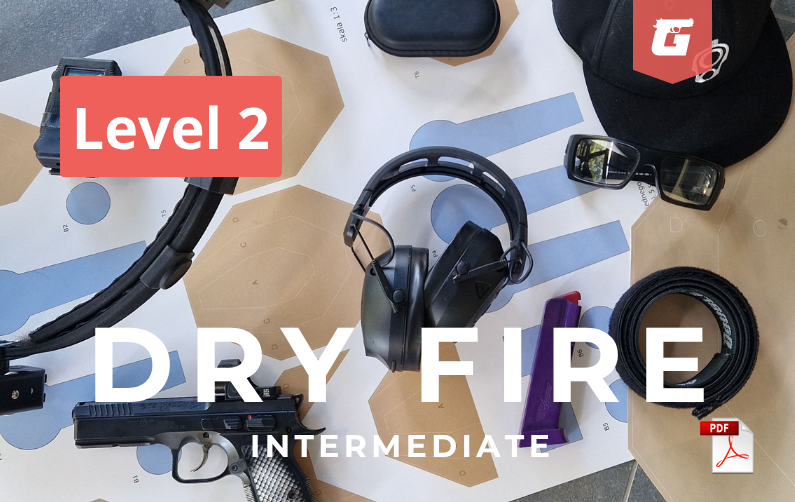
- Level 2 – Intermediate: Pressure & Fluidity → publishes on 27 November 2024
- Level 3 – Advanced: Integration, Stress & Live-Fire Transfer → publishes on 18 December 2024
Each level will come with its own downloadable PDF plan, so you can follow a ready-made training schedule.
Conclusion
Dry fire is more than just “shooting without ammo.” It’s the way to become a better, more confident, and more aware shooter. No cost, no noise – just discipline and consistency.
👉 Question for you: Who here already trains with dry fire regularly? What were the first improvements you noticed?