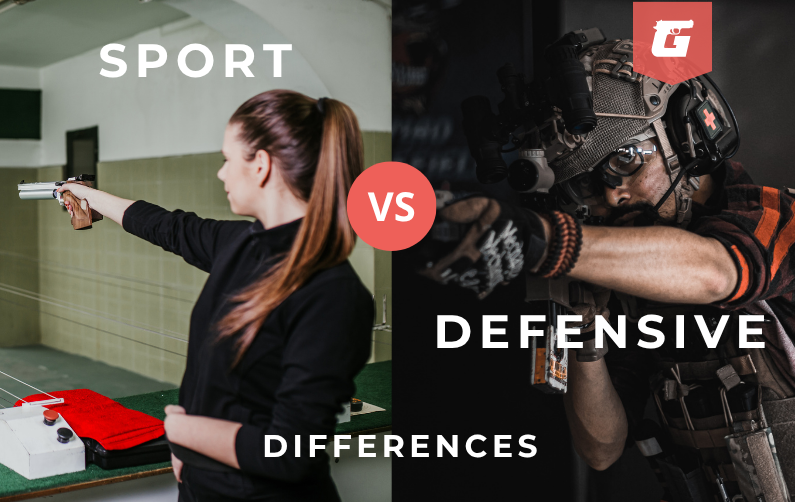
Sport Shooting vs. Defensive Shooting – Key Differences
In our world, shooting is more than just hitting the target. Some of us train for sport and competition, chasing precision and speed. Others focus on defensive skills, where every drill has one goal – survival. Both paths share fundamentals but differ in mindset, priorities, and the environment we train for.
Let’s take a closer look at what separates sport shooting from defensive shooting, and what we can learn from both.
Purpose – Competition vs. Survival
The why defines everything.
Sport shooting is built on clear rules and measurable performance. Whether it’s IPSC, IDPA, or precision rifle, the main objective is to score points, beat the clock, and improve consistency. It’s about control, speed, and accuracy under pressure – but a controlled kind of pressure.
In defensive shooting, there are no referees, no safety zones, and no second chances. The goal is to survive and protect – yourself, your family, or others. It’s not about points but about staying alive and stopping the threat quickly.
“In sport, we shoot to win. In defense, we shoot to live.”
Mindset – Game vs. Reality
The mental game separates the two worlds more than any piece of gear ever could.
Sport shooters thrive on repetition, routine, and optimization. Every stage is planned, rehearsed, and analyzed. The mind stays calm, focused on performance metrics and technique.
Defensive shooters train for chaos. They prepare for the moment when adrenaline spikes, vision narrows, and fine motor skills disappear. Their mental drills focus on situational awareness, decision-making, and controlling fear.
Sport shooting teaches discipline.
Defensive shooting teaches composure under real stress.
Both mindsets matter – together, they build a complete shooter.
Training – Drills vs. Scenarios
Sport shooting training is precise and measurable. It’s about mastering stages, reloads, transitions, and movement efficiency. You can count hits, times, and scores. Every repetition is an opportunity to shave off milliseconds.
Defensive shooting training, however, focuses on context and adaptation. The shooter learns how to draw under pressure, move to cover, identify threats, or protect a bystander. It’s not just about the gun; it’s about reading the situation.
- A sport shooter might train to hit two targets in under 1.5 seconds.
- A defensive shooter might train to draw while moving, issue verbal commands, and fire one accurate shot at close range.
Both require skill. The difference lies in purpose and context.
Gear – Performance vs. Practicality
In sport shooting, gear is optimized for performance and comfort. Light triggers, competition holsters, and custom optics setups make sense when every fraction of a second counts. The gun becomes a finely tuned instrument.
Defensive gear, on the other hand, prioritizes reliability, accessibility, and concealment. It’s built for carry, not for comfort. Holsters must hold up under movement, clothes must allow quick access, and everything must work when adrenaline takes over.
A race gun on the range doesn’t guarantee a safe draw under a jacket in real life.
Train with what you actually carry.
Environment – Controlled vs. Unpredictable
Sport shooting happens in structured environments. Targets are known, distances measured, and safety zones marked. Even when the pressure feels high, the conditions are controlled.
Defensive situations are the opposite – unpredictable, dynamic, and often chaotic. The light may be bad, the target may move, and innocent people might be nearby. There’s no buzzer – only instinct and training.
That’s why many shooters combine the two worlds: sport shooting to refine technique, and defensive training to apply it in real conditions.
What We Can Learn from Both
At GGWG, we believe these two paths don’t compete – they complement each other.
Sport shooting builds:
- Speed, precision, and muscle memory.
- Confidence under time pressure.
- Discipline and consistency.
Defensive shooting builds:
- Awareness and adaptability.
- Real-world mindset and stress control.
- Decision-making under threat.
Put together, they form the complete circle of training – from pure mechanics to mental readiness. The best shooters take the precision of sport and combine it with the realism of defense.
Community Voice
Many of us started on the range, chasing scores. Later, we realized that skill alone isn’t enough – we train because we want to protect what matters.
“Competition gave me confidence. Defensive training gave me purpose.”
That’s what we stand for. Shooting isn’t just about performance; it’s about responsibility, balance, and growth.
Final Thoughts
So, Sport Shooting vs. Defensive Shooting – which is better?
Neither. They serve different purposes but share the same foundation: safety, discipline, and skill.
If you’re serious about being a well-rounded shooter, don’t limit yourself.
- Shoot sport to sharpen your technique.
- Train defense to sharpen your instincts.
Stay safe, stay sharp.
What about you?
Do you train for sport, defense, or both?
What’s one lesson from each that made you a better shooter?
Share it with the community – we grow stronger together.